
By Jude David & Tokunbo Dada
November, 2025
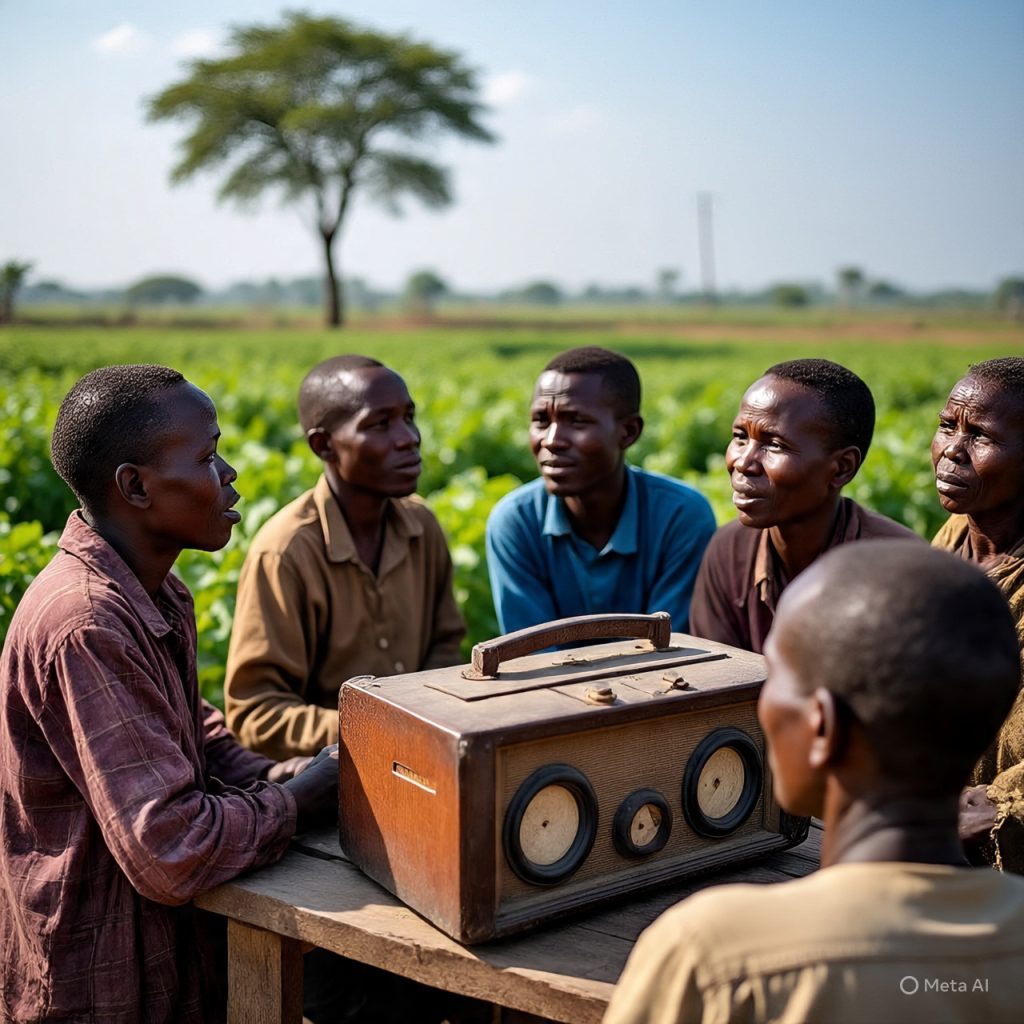
Radio is an important tool for disseminating information to rural populace; it is easy to operate and cheap to access. With over two billion people living in rural communities in developing countries, the importance of radio cannot be over-emphasized (Nakabugu, 2001). Considering the challenge of food security being experienced in the world, particularly, in the developing countries, the need for improved and effective dissemination of agricultural information is vital. Viewing agriculture as a business, Brobbey et al. (2018) explain that the scale of improvement and development a farmer can make is largely dependent on the amount of reliable information available to such farmer. Aligning with this view, Adetuyi et al. (2018) note that many smallholder farmers in sub-Saharan Africa do not have sufficient access to the kind of information they need to improve their scale of production and level of productivity. In Africa, most farmers and agricultural practitioners, especially the smallholders, live in rural areas (Nakabugu, 2001), meanwhile in Nigeria, over 70 percent of the population are involved in agriculture, mostly at subsistence level, producing about 90 per cent of the food in the country from the rural communities (IFAD, 2016). So, according to Adetuyi et al. (2018), in order to improve the productivity of the farmers and other agricultural practitioners, there is need for improvement in the level of access and relevance of agricultural information being diffused to them.
Antwi et al. (2022); Adesina and Ayoola (2025) and Shodipe at al. (2024) submit that radio is an effective medium of diffusing agricultural information to farmers in rural communities, because of the reach of radio, the ability to bypass the literacy barrier, ease of access, and the low cost of purchasing a radio set. It is unfortunate that many radio stations do not have active agricultural radio programme on their schedule, thus denying many farmers and other agricultural practitioners access to agricultural information. For the few radio stations that run agricultural radio programme, it is not automatic that anyone who listens to the programme will accept the message and adopt it in his practice; it is one thing to broadcast agricultural information to farmers, particularly smallholder farmers, but it is another thing for the farmers to be willing to adopt the ideas, innovations and technologies being diffused to them. So, the aim of any agricultural radio production should be to maximize the adoption of the information or messages being broadcast via the radio programme. In order to achieve this, various factors must be considered during production; they include:
Research: extension service employs development communication to achieve behavioural and attitudinal change in the farmers. that In order to improve the productivity of farmers, they should be part of problem identification down to the solution and implementation of the solution; this approach is rooted in Participatory theory of communication. Getting the farmers to participate in the problem solving cycle promotes sustainability of the initiative or the solution. It should also be noted that people tend to be more interested in activities that benefit them, so, in order to attract the interest of the audience (farmers), it is important to produce radio programmes that are relevant to their needs; the problems they face, their dreams, and desires among others. Therefore, research should be conducted to identify these needs; the problem they face in their practice and social lives, and proffer solutions via the radio the programme. This will build a good listenership base, and there would be better chances of adoption of the information being broadcast if it addresses the needs. In 2023, Cultural Survival, USA and paramount FM, Abeokuta, Nigeria collaborated on a campaign to improve the level of Covid-19 vaccination in some farming communities in Ogun State. The first step taken was to have an interactive session with some farmer and sellers of farm produce in four communities across three local government areas. The aim of the interactive session was to find out the current level of vaccination, identify the reason for refusal to get vaccinated, and identify their misconceptions about Covid-19 vaccines. Based on the findings of these interactive sessions, a campaign was designed to address the issues raised during the interactive session, and after 10 months of rigorous campaign, findings showed that many of those who refused to get vaccinated initially have taken their first and second doses of the vaccine (Dada, 2024). The success of that campaign was hinged on the research initially conduction via the interactive session. It is important to identify the mindset of the target audience, their problems, and misconceptions among others before going ahead to design a radio programme for development.
Expert participation: Credibility is very important in development communication. For an agricultural or health radio programme aimed at a change in attitude or adoption of certain innovation or idea, expert opinion gives more credibility to the message; it increases the confidence of the listeners in the radio programme (Farm Radio International, 2014). However, many producers air agricultural radio programmes without having expert views/opinions on the programme , this is not right; when producing an agricultural radio programme, it is important to have the voice of an expert; an extension officer, an experience farmer/practitioner, other relevant experts in the subject matter, or people that have experienced the issue being discussed with relevant results. This kind of production will encourage more audience to listen and the likelihood of adoption will increase. One of the main challenges of producing agricultural programmes on radio is access to experts and extension officers. At the early stage of producing Agbedola, an agricultural radio programme on Paramount FM, Abeokuta, this challenge was very significant, however after creating a partnership the Ogun State Agriculture Development Programme, OGADEP, access to experts became easy, raising the quality of the programme and the benefits derived by the audience.
Interactivity: When producing a radio programme targeting farmers and other rural populace, particularly when the programme is meant to diffuse new ideas and innovations to the audience, it is important to ensure that the people can talk back; they have a feedback channels with which they can ask questions, make their contributions, agree or disagree with the views of the experts on the programme whether it is a live or recorded broadcast. Interactivity on such programme makes the audience feel like a part of the production, and it gives room for their doubts and confusions to be cleared on time, it also helps to gauge the level of comprehension of the audience with respect to the subject matter. FRI (n.d.) opines that the listeners must have an opportunity to discuss matters that are important to them on the programme. As much as live broadcast is preferable for agricultural broadcast as it gives room for immediate feedback. This feedback can be used to gauge the level of listener’s comprehension and, at times, their decision on the adoption of the ideas being transmitted to them via the radio programme. Vox pops, text messages, and voice recordings can be utilised as feedback channels for interactivity in a recorded broadcast. If the target audience are poor, it is possible that they would rather save their money for food rather than use it to call-in on a radio programme or send text messages, thus hindering the contribution and participation of poor smallholders on the programme. A toll free technology may save this situation. Farm Radio International adopted this technology during their partnership with some radio stations across Nigeria including Amuludun FM, BCOS, and Paramount FM in 2021-2023; it allows the audience to call a particular line after the radio programme has been aired and ask their questions. Their question would be recorded and the production will harvest all the question before the next edition of the radio programme, and get the experts featuring on the programme to answer those questions. However, the top-down communication approach of many radio stations has led them to neglect the need for interactivity as well as the need for the target audience to be a part of the production from the beginning.
Language of broadcast: The essence of information is for understanding; the sender of the message intends for the receiver to understand the message and take a particular action. Taking the low literacy level among farming communities into consideration, it is important to note that broadcast in English and other foreign languages will create a literacy barrier for the audience, and they will not be able to comprehend the messages being diffused via the radio programme. In order to ensure better understanding and comprehension, it is important to broadcast agricultural radio message sin local languages; languages spoken in rural communities.
Time of broadcast: The time of broadcast will determine the number of listeners that will be available to listen to the programme. It is important to conduct a survey of the targeted population; eliciting their views on the time that will be comfortable for them to listen to the radio programme. Producers should not assume that the audience will be available at a certain period of the day. Also, it should be noted that the time a male farmer will be available to listen to a radio programme is not necessarily the time comfortable for a female farmer to listen to the same programme, thus it is important to conduct the survey for both male and females. In a situation where the time preferred by most of the female farmer is different from the preference of the male farmers, it is suggested that a repeat edition of the programme is aired. The original broadcast will fit the time for one of the preferred time while the repeat broadcast will fit the second. This way, all parties will be well taken care of.
Entertainment: In a country like Nigeria where economic challenges can be a torture, a lot of people don’t want to listen to programmes that are ‘hard’ (brain tasking); they just want to be entertained. This school of thought is founded in the Play Theory of communication which states that people come to the media to be entertained. Normally, agriculture programmes may not be so interesting or entertaining, so, there is a tendency for people who have gone to work or hustle all day not to be inclined to listen to a programme that requires a lot of their concentration and brain power. For this reason, producers are encouraged to go the extra mile to make agricultural radio programmes more interesting by incorporating items like music, farmers’ story, drama etc. This may also encourage more listeners to stay on the channel.
Recap: At the beginning of an agricultural radio programme, it is important to give a recap of the last episode of the programme, in doing this, it reminds those that have forgotten when was discussed while informing those who did not listen to the last episode of what was discussed. Also, the recap is supposed to a summary of the key issues; perhaps about 3-4 points. Also, when making the closing remark on the programme, a recap of the key issue raised during the programme should be made. This reminds the listeners, and informs those who joined late of the key issues discussed
Intro/Outro: The intro is the opening segment that introduces the programme, presenter, station, and purpose of the broadcast, while the outro is the closing segment that signals the end of the programme; leaving a final impression on the audience. Together, they frame the programme and provide identity, direction, and closure. A good intro creates an impression of the programme in the mind of the audience; it is a determining factor on whether the listeners (first time listener or regular) will stay to listen to the rest of the programme. In order to keep the audience for the rest of the radio programmes it is important that the presenter give bits of what is in the package for the edition and what the programme is about each time he/she goes on air. This few revelation of what the programme entails will either make the listeners stick with the programme or tune off. For an agricultural radio programme, Farm Radio International strongly recommends that a recap of the key issues from last episode be done, perhaps in few sentences, so as to remind those that listened of the key points of discussion while those that missed the last episode will be able to get a summary. Outro is equally essential because it provides a sense of completion and reinforces the programme’s message. A well-crafted outro summarizes key points, appreciate listeners, promotes future programmes and encourages continued listenership. By the time the programme is about to end, it is important for the presenter to give a quick recap- reminder of the key learning points as discussed during the agricultural radio programme. This method reinforces the listener’s learning and increases the chances of adoption.
Value Chain Production: As the saying goes – a chain is as strong as its weakest link. Applying this to food security, the food supply system is a chain, a collection of various elements that must all function well in order to achieve food security. It starts with food production, but it extends to marketing, transportation and processing among others. Financing, insurance, labour, input supply and so on, are some others issues that are critical to food security and sustainability of the food supply chain, thus it is important that agricultural radio presenters/ producers cover these thematic areas in their production so as to contribute effectively to food security in the country. However, many agricultural radio programme seem to focus on production (planting to harvesting) alone without due consideration for other elements of the value chain.
If all the factors mentioned about are put into consideration during the production of an agricultural radio programme, the likelihood of adoption of the innovation and ideas being advocated in the programme will increase. However, the expertise of the production team should not be neglected. Agricultural broadcast is a specialised field of broadcast. In 2022, while investigating the baseline knowledge of some farmers organisations in Ogun State, it was realised that majority of the farmers have poor knowledge of insurance and they are not aware of the existence of National Agricultural Insurance Corporation (NAIC), while many also believe that the premium to be paid for agricultural insurance is astronomical, contrary to the reality on ground. This situation has denied many farmers the opportunity to mitigate their losses via adoption of insurance policy. So, it is important for the presenters, producers, and other members of the production team to be well trained and be skilled so as to be able to achieve the best result.
Conclusion
Radio is important to the diffusion of agricultural innovations, but the efforts put into the production of the radio programmes will be a waste if the audience do not adopt the innovations, ideas or technologies being diffused via the programme. So, factors that can influence adoption such as language of broadcast, production planning, research, time of broadcast, entertainment element, recap element, interactivity, appropriate resource persons and the skill level of the production team should be given adequate attention.
Reference:
Adesina, K. and Ayoola, M. J. (2025). Influence Of Radio On Agricultural Communication Among Farmers In Yewa South Local Government Area Of Ogun State. International Journal of Academic Management Science Research (IJAMSR), 9 (1): 97-103.
Adetuyi1, O. K.; Olayide, O. E. and Smith, G. (2018). Assessing Communication Channels for Scaling-up of Climate Smart Agriculture among Smallholder Farmers in Northern Uganda.
Antwi, E.; Tham-Agyekum1, E. K.; Aidoo, D. C.; Boansi, D. and Okorley, E. L. (2022). Patronage of Farm Radio as an Agricultural Knowledge Source for Farmers: Experiences from Ghana. Journal of Media and Communication Studies, 14 (1): 8-16. DOI: 10.5897/JMCS2021.0757
Brobbey, L.; Dapaah, J. M.; Acheampong, P. P.; Manu-Aduening, J.; Haleegoah, J. and Frimpong, B. N. (2018). Exploring The Different Path Ways Influencing Adoption Of Improved Cassava Technologies. Paper presented at Ghana Association of Agricultural Economists (GAAE) 2nd GAAE Conference, 9th – 11th August 2018. Ghana’s Agriculture, Food security and Job creation.
Dada, T. S. (2024). Nigeria Radio Project Bridges Gap Between Doctors and Farmers Vaccines. www.culturalsurvival.org/news/nigeria-radioprojectbridges-gap-between-doctors-and-farmers-vaccines
Farm Radio International. 2023. Empowering Nigerian Farmers Through Radio. Retrieved from https://farmradio.org
Farm Radio International (n.d.). Know Your Audience. https://farmradiotraining.org/mod/scorm/player.php?a=83¤torg=articulate_rise&scoid=166
Nakabugu, B. (2001), The Role of Rural Radio in Agricultural and Rural DevelopmentTranslating Agricultural Research Information into Messages for Farm Audiences.https://www.fao.org/4/x6721e/x6721e31.htm
Shodipe, O.A.; Sanusi, B.O.; Talabi, F.O. and Adelabu, O.T. (2024). Influence of farm radio international radio programmes on farmers in Oyo State, Nigeria.Corpus Intellectual,3(2).ISSN Print 2811-3187 Online 2811-3209.
About the Authors:
Jude Toluwani David is a radio broadcaster, he also worked with Farm Radio International as M & E Officer in Ogun State 2021-2023, and M&E officer for Oyo and Ogun State in 2024
Tokunbo Stephen Dada is an agricultural radio producer and development communicator
